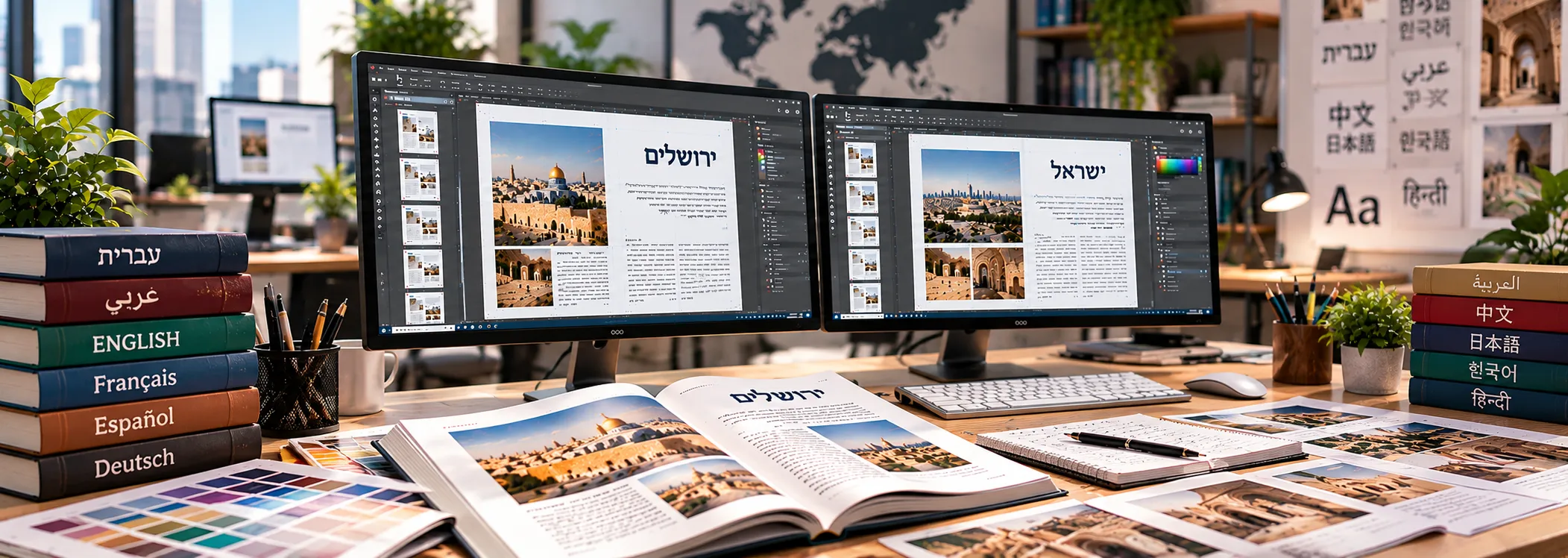
RTL DTP Services for Arabic, Hebrew, Persian, Urdu and Other Right-to-Left Languages
Translating a document into Arabic, Hebrew, Persian or Urdu is only half the job. The text still has to be placed, flowed, joined and mirrored correctly, or the finished piece looks wrong to every native reader who opens it. Our RTL DTP services take your translated content and turn it into a polished, print-ready or digital-ready layout that reads naturally from right to left.
Global Digital DTP formats right-to-left documents for translation agencies, publishers, manufacturers, training providers and corporate teams. We work in Adobe InDesign, Microsoft Word, PowerPoint and other common authoring tools, and we deliver files your team or your printer can use without further fixing.
What Are RTL DTP Services?
RTL DTP (right-to-left desktop publishing) is the process of laying out text and graphics for languages written from right to left, such as Arabic, Hebrew, Persian (Farsi) and Urdu. It goes well beyond swapping the text direction. A proper RTL layout rebuilds the page so the reading order, alignment, navigation, numbering and visual hierarchy all feel native.
That usually means:
- Setting text with a right-to-left paragraph direction and the correct script engine
- Mirroring columns, tables, bullet lists, page numbers, headers and footers
- Handling mixed-direction content, such as English product names, URLs and numbers inside Arabic sentences
- Choosing fonts that cover the target language properly and match the original design
- Rechecking spacing, line breaks, justification and overflow after translation
- Exporting clean, print-ready PDFs or editable source files
When this work is done by general-purpose designers who do not work with RTL scripts every day, the results often include broken letter joins, flipped punctuation, reversed numbers and lines that end in the wrong place. Fixing those problems after printing is expensive. Getting them right the first time is the reason specialist RTL typesetting exists.
RTL Languages We Support
We provide RTL DTP services for the full range of right-to-left scripts our clients ask for:
- Arabic (Modern Standard Arabic and regional content for Gulf, Levant and North African markets)
- Hebrew
- Persian (Farsi) and Dari
- Urdu, including Nastaliq-style typesetting where the project calls for it
- Pashto
- Kurdish (Sorani)
- Sindhi and Uyghur
- Yiddish
If you need a language that is not listed, ask us. We will confirm font coverage, tool support and reviewer availability before you commit.
We also lay out left-to-right and right-to-left versions side by side, so you can keep a bilingual brochure, manual or report consistent across both editions. See our Multilingual DTP page for how we handle mixed-language projects.
Why RTL Layout Is Harder Than It Looks
Right-to-left typesetting has technical details that do not exist in English layout. Knowing them is what separates a clean file from one that needs three rounds of corrections.
Bidirectional Text
Real-world documents are rarely pure RTL. An Arabic paragraph may contain a brand name in Latin letters, a phone number, a model code and a web address. Each of those runs left to right inside a right-to-left line, and the software has to be told how to order them. Punctuation next to those embedded items is where most errors happen. We check every mixed-direction line manually.
Letter Joining and Script Shaping
Arabic, Persian and Urdu letters connect to each other, and each letter changes shape depending on its position in a word. If the wrong text engine or font is used, letters appear disconnected or in the wrong form. We use the correct script engine for each language and confirm the result on screen and in the exported PDF.
Numerals
Different markets use different digit systems. Arabic content may use Western digits (0–9) or Eastern Arabic-Indic digits, and Persian and Urdu use their own variants. We follow your style guide or the convention of your target region, and we keep it consistent from the first page to the last.
Punctuation and Brackets
Question marks, commas, parentheses and quotation marks have to be the right glyphs and sit on the right side of the text. Brackets that wrap mixed-direction content are a common failure point. We verify each one.
Justification and Spacing
Arabic justification is not done by simply stretching word spaces. Professional layouts use controlled elongation of letters (kashida) or careful spacing, depending on the font and the design. Hebrew has its own spacing rules and, in some publications, vowel marks that affect line height. We tune these settings so paragraphs look even without distorting the text.
Hyphenation
Arabic and Hebrew text is not hyphenated the way English is. Layouts have to handle line endings through spacing and rewrapping rather than word breaks. We design around this instead of leaving awkward gaps.
Font Selection
An English typeface does not have an Arabic or Urdu equivalent that is identical, so we choose a font that matches the weight, tone and purpose of the original design. We confirm font licensing for commercial use and for embedding in PDFs and e-books, and we can use your brand fonts when they cover the language.
What We Mirror, and What We Do Not
Mirroring a layout does not mean flipping everything. We make these decisions page by page.
Elements we typically mirror:
- Text alignment and reading order
- Column order and table column order
- Page numbers, headers, footers and running heads
- Bullet and numbered list indents
- Progress bars, timelines, arrows and navigation elements
- Table of contents and index structure
- Page progression in books (binding moves to the right-hand side)
Elements we usually leave unchanged:
- Logos and brand marks
- Photographs of people, products and places (unless they contain text)
- Charts that show time moving left to right in a way native to the data (we confirm with you)
- Product images, diagrams and technical drawings where flipping would change meaning
- Phone numbers, equations, code and Latin-script strings
When an image contains embedded text, we can handle it through image localization or recreate it with the translated text.
Our RTL DTP Services
RTL Document Formatting in Word and PowerPoint
We format translated Word documents and PowerPoint presentations with proper RTL direction, styles, tables, headers and slide masters, so your team can keep editing the files. Learn more on our Word & PowerPoint DTP Services page.
RTL InDesign Layout
For brochures, catalogs, reports, magazines and manuals, we build RTL layouts in Adobe InDesign using its right-to-left capable composition tools, paragraph styles and master pages. You get a clean package with linked images, fonts and a print-ready PDF. See our InDesign DTP Services page for the full process.
RTL Book Typesetting
We typeset books for right-to-left readers, including page progression, footnotes, chapter openers, running heads, indexes and cover wraps. We prepare print files and e-book formats with the correct reading direction. More detail is on our Book DTP & Typesetting Services page.
Converting Existing PDFs to Editable RTL Files
If you only have a final PDF, we can rebuild it as an editable file, then translate and typeset it. For scanned material, we pair this with OCR services and multilingual OCR to extract the text accurately before layout begins. Our PDF to InDesign Conversion Services page explains that workflow.
Technical Documentation and Manuals
User guides, safety instructions, installation manuals and datasheets need exact alignment of text, callouts and figure numbers. We maintain call-out positions, translate-ready tables and consistent terminology across the whole document.
Marketing and Corporate Materials
Brochures, flyers, annual reports, presentations, packaging inserts, product sheets, posters and banners. We keep your brand look while giving each page a layout that feels designed for the local audience.
Forms, Legal and Regulatory Documents
Contracts, forms, certificates and regulatory submissions often need strict page matching with the source. We keep page breaks, numbering and clause structure aligned so cross-references still work.
E-Learning and Training Content
We help prepare slide-based training, handouts and course manuals in RTL languages, and we flag content that needs review by your e-learning team.
How Our RTL DTP Process Works
- Project review. You send the source files, translated text and any style guides, glossaries and fonts. We check formats, languages, page count and special requirements.
- Technical setup. We set up the right language, direction, fonts and styles in the tool we will use, and we run a test on a representative sample page when the project calls for it.
- Layout and typesetting. Our team places the translated text, mirrors the layout, adjusts graphics and fixes overflow, line breaks and mixed-direction content.
- Quality checks. We check each page against the source for completeness, direction, numbering, punctuation, fonts, links, images and consistency. Where you have a linguist or reviewer, we make it easy to send corrections back.
- We apply your reviewer’s edits and re-verify the affected pages, including tables of contents, cross-references and page numbers.
- You receive the files you asked for: native source files, a print-ready PDF or an e-book package. See our print-ready file preparation details for specifications such as bleed, color profiles and fonts.
Quality Checks We Run on Every RTL File
- Text direction and alignment correct on every page, including tables, captions and footers
- Letters join and display correctly, with no missing or substituted glyphs
- Numbers, dates, units and currencies follow the agreed convention
- Punctuation and brackets sit in the correct place, especially around Latin text
- No text overflow, orphan lines or unintended line breaks
- Page count, page breaks and cross-references match the source where required
- Fonts embedded or packaged as agreed
- Images, charts and icons mirrored or kept as planned
- PDF bookmarks, hyperlinks and tagging checked when you need an accessible file
- Final comparison against the source file
Industries We Serve
We support RTL typesetting for translation and localization agencies, publishers and authors, pharmaceutical and medical device companies, manufacturing and engineering firms, software and hardware companies, financial and legal services, education and training providers, government and non-profit organizations, and marketing and advertising teams.
File Formats and Tools
Input: InDesign (INDD, IDML), Word (DOCX), PowerPoint (PPTX), Illustrator (AI), PDF (including scanned PDFs after OCR), Excel (XLSX), and other common source formats on request.
Output: InDesign packages, Word and PowerPoint files, print-ready PDF, web-optimized PDF, accessible PDF where requested, and EPUB for e-books.
Tell us the software version you use when you request a quote, and we will match it so your team can open and edit the files without conversion problems.
Why Choose Global Digital DTP for RTL Projects
- Specialist focus. DTP is our core work, not a side service. We handle RTL languages alongside CJK, Indic and European languages, so your multilingual set stays consistent across all versions.
- Layout that respects the source design. We keep your brand, grid and hierarchy intact while adapting what has to change.
- Clear communication. You get a clear scope, a clear timeline and a point of contact for questions and corrections.
- Flexible workflow. Send translated text with or without source files, one language or twenty, one document or a full catalog. See how this works in our multilingual typesetting guide.
- We treat your files as confidential and can work under an NDA when your project requires it.
- Scalable production. Our team can handle both single documents and large, repeating volumes, so you can use us for ongoing localization programs.
Tips for Getting the Best Result from an RTL DTP Project
- Send source files, not only PDFs. Editable InDesign or Word files let us keep your design faithful and reduce cost.
- Finalize the translation before layout. Late text changes are the most common cause of delays and extra cost in any DTP project.
- Share your brand fonts and style guide. Tell us if the fonts support the target script, and we will propose alternatives if they do not.
- Decide on numerals and terminology early. Tell us the market, whether to use Western or Eastern Arabic-Indic digits, and which glossary to follow.
- Plan for text expansion and contraction. Arabic text can run shorter or longer than English depending on the content, so leave room in the design when possible.
- Arrange a native-speaking review. A reviewer who reads the typeset proof catches layout-level issues that a spell check will not.
- Tell us where the file will be used. Print, web, mobile and e-book each need different export settings.
Frequently Asked Questions About RTL DTP Services
What does RTL DTP mean?
RTL DTP stands for right-to-left desktop publishing. It is the process of formatting and laying out documents in languages that read from right to left, such as Arabic, Hebrew, Persian and Urdu, so the final file looks and reads correctly for native readers.
Which RTL languages do you work with?
We work with Arabic, Hebrew, Persian (Farsi), Dari, Urdu, Pashto, Kurdish (Sorani), Sindhi, Uyghur and Yiddish. Contact us if you need another right-to-left language and we will confirm the details.
Do you also translate the content?
Our core service is layout and typesetting. If you already have translated text, send it with your source files. If you need translation, we can discuss options as part of your project. Visit our localization services page for more.
Can you work from my InDesign, Word or PowerPoint files?
Yes. We work directly in InDesign, Word and PowerPoint, and we return files in the same format along with a print-ready PDF. You can edit them afterward.
What if I only have a PDF?
We can rebuild the document as an editable file. For scanned PDFs, we first extract the text with OCR. The effort depends on how complex the layout is, so send a sample for a precise quote.
Do you mirror images and graphics?
We mirror only what should be mirrored, such as navigation arrows, timelines and layout-dependent graphics. Logos, product photos and technical drawings are usually left as they are. We confirm these decisions with you at the start.
Will my Arabic or Urdu text display correctly in print and on screen?
Yes. We use the right script engine and fonts, embed or package them correctly, and check the exported PDF page by page, including joined letters, numerals and punctuation.
How do you handle English words and numbers inside RTL text?
We set each mixed-direction run explicitly and check the result manually, because automatic ordering often misplaces punctuation, brackets and numbers next to Latin text.
Can you create left-to-right and right-to-left versions of the same document?
Yes. We keep both versions consistent in structure, styles and visual design, and we can maintain them together for future updates.
How is an RTL DTP project priced?
Pricing depends on the number of pages, file format, layout complexity, language, number of images or graphics to adapt, and delivery timeline. Many projects are quoted per page or per project. Request a free quote with your files for a precise estimate.
How long does an RTL DTP project take?
Timelines depend on page count, complexity and the number of review rounds. Share your deadline when you request a quote and we will confirm what is realistic.
Can you keep my files confidential?
Yes. We handle all client files as confidential and can sign an NDA before you send material.
Get a Quote for RTL DTP Services
If you have a translated document that needs a professional right-to-left layout, send us your files and tell us the language, software, page count and deadline. We will review them and reply with a clear quote and timeline.
Our RTL DTP services help you publish Arabic, Hebrew, Persian and Urdu content that looks right, reads right and is ready for print or digital release.
Email: info@globaldigitaldtp.com | Phone/WhatsApp: +91 8826707501