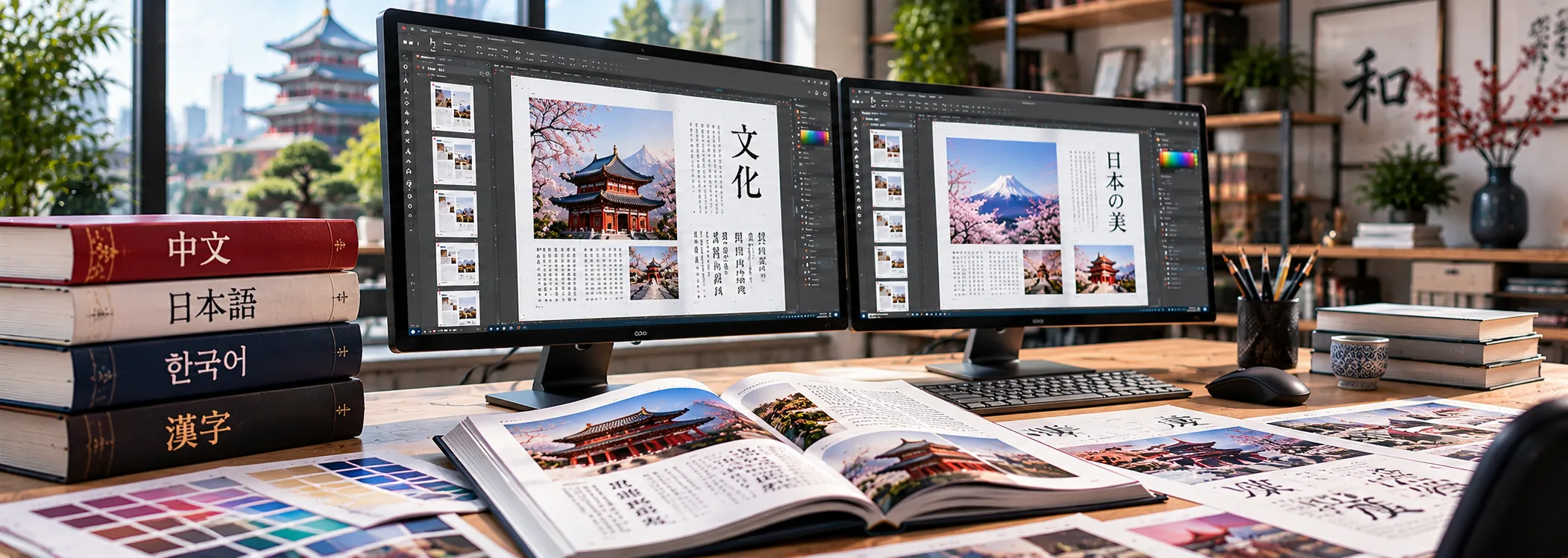
CJK DTP Services for Chinese, Japanese, and Korean Documents
Your translation is finished. Now it has to look right. We provide CJK DTP services that place Chinese, Japanese, and Korean text into brochures, manuals, books, presentations, and packaging with correct fonts, line breaking, and print-ready output, so your document reads as if it was designed in the target language from the start.
Support for Simplified Chinese, Traditional Chinese, Japanese, and Korean · InDesign, Word, PowerPoint, Illustrator, and PDF files · Native-speaker review available
What Are CJK DTP Services?
CJK DTP services are desktop publishing services for documents in Chinese, Japanese, and Korean. They cover everything that happens after translation: placing the translated text into the original layout, choosing suitable fonts, applying language-specific typography rules, fixing text that no longer fits, and delivering files that are ready for print or digital release.
CJK DTP is a specialist task because these languages do not behave like English or other Latin-script languages. There are no spaces between words, line breaks follow their own rules, thousands of characters need font coverage, and each language has its own conventions for punctuation, numerals, and text direction. A layout that works in English can break the moment CJK text is dropped in.
At Global Digital DTP, we handle this work as part of our wider multilingual DTP offering. You send the translated text and your source files, and we return a finished, consistent layout in every CJK language you need.
Our CJK DTP Services
Chinese DTP Services (Simplified and Traditional)
We typeset Chinese documents for mainland China, Taiwan, Hong Kong, and Singapore audiences. Simplified and Traditional Chinese are treated as separate typesetting jobs, because character forms, font choices, punctuation habits, and regional conventions differ. We select fonts that suit your content, whether that is a corporate report, a technical manual, or consumer packaging, and we check that every character renders correctly with no missing glyphs or fallback boxes.
Japanese DTP Services
Japanese typesetting mixes kanji, hiragana, katakana, and often Latin letters and numerals in the same line. We apply kinsoku line-breaking rules, handle punctuation spacing, and set mixed-script text so it flows naturally. We also work with vertical (tategaki) and horizontal (yokogaki) layouts, ruby annotations (furigana) where needed, and the line spacing and font weights that make Japanese pages comfortable to read.
Korean DTP Services
Korean text uses Hangul, with optional Hanja in some contexts, and is normally set with spaces between words. We handle line breaking, justification, and font pairing so Hangul pages look balanced and professional, and we keep product names, numerals, and Latin text consistent with the rest of the document.
Multi-Language CJK Layouts
Many projects need Chinese, Japanese, and Korean at the same time, often alongside English and other languages. We build these as a single controlled project with a consistent grid, style system, and naming, so every language version matches in structure and quality. For languages that read right to left, see our RTL DTP services.
What Makes CJK Typesetting Different
These are the issues we check on every CJK project:
Font coverage and selection. CJK fonts contain thousands of glyphs, and not every font supports every character. We choose fonts with full coverage for your text, match weights and styles to the original design, and confirm licensing is suitable for your use. Where the design calls for a Latin typeface alongside CJK text, we pair them so sizes and baselines look balanced.
Line breaking and punctuation rules. Chinese, Japanese, and Korean each follow different rules about which characters may begin or end a line. Japanese kinsoku rules are the best known, and ignoring them produces awkward breaks that native readers notice at once. We apply the right composer settings in InDesign and review the result line by line.
Text expansion and contraction. CJK text is usually more compact than English, but not always in the same proportion. Headlines may shrink while body text, once Latin terms and numerals are included, may behave differently. We rebalance spacing, leading, and layout so pages do not look sparse or crowded.
Vertical and horizontal text. Japanese, and sometimes Chinese, can be set vertically. Vertical text changes how numerals, punctuation, and Latin words are rotated or upright, and it affects page progression in books. We set these correctly and flag any design decisions that need your input.
Characters and numerals. Full-width and half-width characters, punctuation forms, and date and number formats all vary by language and region. We follow the conventions of your target market and apply them consistently.
Graphics, charts, and images with text. Text inside images, diagrams, and screenshots has to be translated and rebuilt too. We handle this with our image localization services, including editable text, native-looking labels, and consistent styling.
Documents We Typeset in CJK Languages
- Brochures, catalogs, and marketing collateral
- User manuals, technical documentation, and product guides
- Books, e-books, and long-form publications (see Book DTP & Typesetting Services)
- Annual reports, financial documents, and corporate presentations
- Training materials and e-learning handouts
- Packaging, labels, and inserts
- Forms, contracts, and regulatory documents
- Word and PowerPoint files (see Word & PowerPoint DTP Services)
File Formats and Software We Work With
We work in the tools your team already uses, with InDesign DTP services as our core production environment for CJK layouts.
- Adobe InDesign (INDD, IDML, INDB)
- Adobe Illustrator and Photoshop for graphics with text
- Microsoft Word and PowerPoint
- PDF files, including those without editable source files
- Other formats on request; send us what you have and we will confirm feasibility
If you only have a PDF, we can rebuild it as an editable file through our PDF to InDesign conversion services, and for scanned documents we can combine this with multilingual OCR services. Learn more about what is possible with or without source files.
Our CJK DTP Process
1. Review your files and brief. You send source files, translated text, and any style guides or reference material. We review the content, identify the languages and regions, and confirm scope, formats, and deadlines.
2. Prepare the layout. We set up the project with correct language settings, fonts, paragraph and character styles, and composer rules, so the foundation is right before any text is placed.
3. Typeset the translated text. We flow the translated content into the layout, rebuild tables, charts, and graphics as needed, and adjust spacing and line breaks to suit each language.
4. Quality check. We proof the layout for missing glyphs, broken lines, inconsistent styles, overset text, and mismatches against the source. If you have a native reviewer, we make their corrections quickly; if you need one, we can arrange native-language review.
5. Deliver print-ready and digital files. We deliver final, organized files, including editable source files, packaged fonts and links where licensing permits, and PDFs prepared to your print or screen specification. See print-ready file preparation for details.
Why Choose Global Digital DTP for CJK DTP
- Specialist focus on multilingual layout. CJK typesetting is part of our everyday multilingual workflow, not an afterthought.
- Layouts that match your original. We preserve your brand, grid, and design intent while respecting each language’s typographic rules.
- One partner for every language. Chinese, Japanese, and Korean can be delivered together with your other target languages, with consistent quality and structure.
- Flexible capacity. Agencies and in-house teams can use us as an extension of their production team. See our DTP outsourcing services for how this works.
- Clear communication. You get a straightforward quote, realistic timelines, and questions raised early rather than problems found late.
- Confidential handling. Your files and content are treated as confidential, and we are happy to discuss NDAs before you send anything.
Who We Work With
Our CJK DTP services support translation and localization agencies that need reliable layout capacity, marketing and design teams preparing campaigns for Asian markets, manufacturers and technology companies localizing manuals and product documentation, publishers and authors releasing CJK editions, and corporate teams producing reports and presentations in several languages.
If your project also involves translation and adaptation, see our localization services.
Frequently Asked Questions About CJK DTP Services
What does CJK stand for in DTP?
CJK stands for Chinese, Japanese, and Korean. In DTP, it refers to the typesetting and layout of documents in these three languages, which share some character sets but differ in writing systems, punctuation, and typographic conventions.
Is CJK DTP more expensive than typesetting in European languages?
It can be, because it requires specialist knowledge of fonts, line-breaking rules, and quality checks. Price depends on page count, complexity, number of languages, file formats, and turnaround. Send us your files for a clear free quote.
Do you offer Simplified and Traditional Chinese typesetting?
Yes. We treat them as separate projects, using appropriate fonts, punctuation, and regional conventions for mainland China, Taiwan, Hong Kong, or Singapore.
Can you typeset Japanese vertical text?
Yes. We can set Japanese in vertical or horizontal orientation, including ruby annotations, correct handling of numerals and Latin text, and book-style page progression where required.
Do I need to provide the translated text, or can you translate as well?
You can send translated text ready for layout. If you need translation, we can coordinate it as part of our localization services, so translation and DTP run as one project.
Which file formats can you work with?
We work with InDesign, Illustrator, Photoshop, Word, PowerPoint, and PDF files. If you only have a PDF or a scan, we can rebuild it into an editable layout.
Can you work from a PDF if I do not have the original files?
Yes. We can recreate the layout in InDesign from your PDF, then typeset the CJK text. Scanned documents can be processed with OCR first.
Do you check the final layout with native speakers?
We check for technical and layout errors on every project. If you need a native-language review of the typeset pages, we can arrange it or work with your own reviewer’s corrections.
How long does a CJK DTP project take?
Timelines depend on page count, languages, and complexity. Short documents can often be turned around quickly; larger or multi-language projects are scheduled with you when we quote. Rush options may be available.
Can you deliver print-ready files?
Yes. We deliver PDFs and source files prepared for your printer’s specifications, including bleed, crop marks, color settings, and font handling.
Get a Quote for CJK DTP Services
Send us your files and tell us which languages, formats, and deadline you have in mind.
We will review the material and reply with a clear quote and timeline.
Email: info@globaldigitaldtp.com | Phone/WhatsApp: +91 8826707501