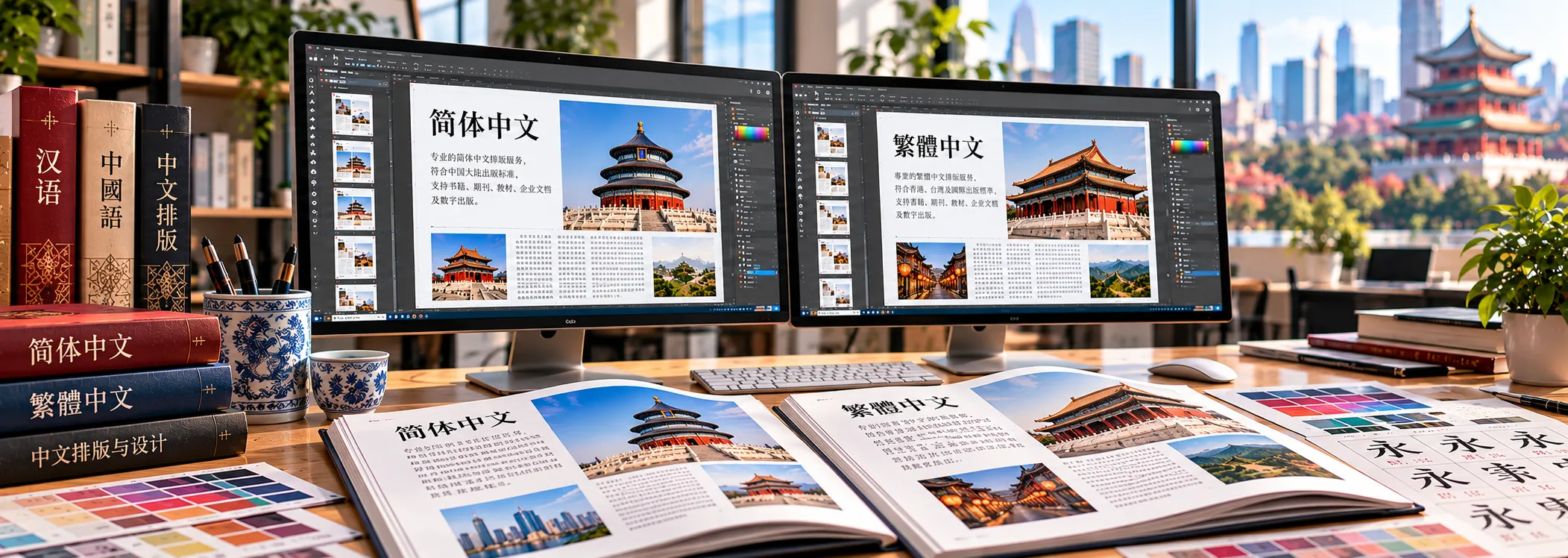
Chinese DTP Services for Simplified and Traditional Chinese Layouts
Translated Chinese text is only half the job. Once it is poured into a brochure, manual, catalog, e-book or presentation, the layout has to look and read like it was designed in Chinese from the start. Our Chinese DTP services take your translated files and turn them into clean, consistent, print-ready and digital-ready documents, without broken characters, wrong fonts or awkward line breaks.
Global Digital DTP supports translation agencies, publishers, marketing teams and manufacturers who need dependable Chinese desktop publishing, in Simplified Chinese (zh-Hans), Traditional Chinese (zh-Hant), or both in the same project.
What Are Chinese DTP Services?
Chinese DTP (desktop publishing) is the process of placing translated Chinese text into a designed layout and adjusting everything that changes because of the language: typefaces, character spacing, punctuation, line breaking, text flow, and the way Chinese and Latin characters sit together on one line.
It is not a copy-and-paste step. Chinese has no word spaces, uses full-width punctuation, follows its own rules for what may not start or end a line, and needs fonts that cover the right character set for each region. A layout built for English will almost always need rework before Chinese text looks correct in it.
Our team handles that rework so your translators can focus on language and your designers can focus on design.
Chinese Typesetting Services We Offer
Simplified Chinese DTP
Layouts for readers in mainland China, Singapore and Malaysia, using Simplified characters and the punctuation conventions those markets expect. Suitable for product manuals, brochures, annual reports, training material, packaging inserts and marketing collateral.
Traditional Chinese DTP
Layouts for Taiwan, Hong Kong and Macau, using Traditional characters, region-appropriate fonts and the correct typographic conventions. We set Traditional Chinese separately from Simplified rather than converting one into the other, because vocabulary, glyph shapes and punctuation habits differ by region.
Bilingual and Multilingual Layouts
English and Chinese side by side, Chinese alongside Japanese or Korean, or Chinese inside a larger multilingual set. We keep one master layout structure so every language version stays consistent. See our multilingual DTP services for projects covering many languages at once.
Chinese Layout from Source Files
If you have the original InDesign, Illustrator, FrameMaker or Office files, we work directly in them, replace the English with Chinese, and keep the original design intact wherever possible.
Chinese Layout Without Source Files
If you only have a PDF or printed sample, we can rebuild the document from scratch in an editable format. This is common for older manuals and files where the original designer is no longer available.
What Makes Chinese Layout Different
These are the details that separate professional Chinese typesetting from text that has simply been pasted in.
- Font selection and coverage. Chinese fonts must support every character in your text, and the right choice differs between Simplified and Traditional. We select suitable, licensed typefaces and check for missing glyphs, fallback fonts and mixed-font problems before delivery.
- Chinese uses full-width punctuation, and its position in the character cell differs between mainland and Taiwan conventions. We apply the correct style for your target region and keep it consistent across the document.
- Line breaking rules. Certain punctuation marks must not begin a line, and others must not end one. We configure line-breaking and hanging punctuation so lines break cleanly without leaving orphaned marks.
- Spacing between Chinese, Latin text and numbers. Brand names, model numbers, units and abbreviations often sit inside Chinese sentences. We adjust spacing and font pairing so the two scripts look balanced.
- Text expansion and contraction. Chinese is usually much shorter in character count than English, but it often needs a larger point size and more generous leading to stay readable. We resize and re-flow text boxes, tables and callouts accordingly.
- Bold, italic and emphasis. Chinese typography does not use italics the way Latin scripts do. We replace faux italics with suitable alternatives such as weight changes, emphasis marks or colour, in line with your style guide.
- Vertical text and special features. Where a project calls for vertical setting, ruby annotations such as pinyin or zhuyin, or other specialised formatting, we set it up properly rather than approximating it.
- Tables, charts and numbered lists. Cell widths, number alignment, bullet styles and chart labels are checked and adjusted after translation.
- Quotation marks and date, number and unit formats. We follow the conventions you specify for your target audience.
Files and Formats We Work With
We handle Chinese DTP in the formats most commonly used for business and publishing work:
- Adobe InDesign (INDD, IDML) – see our InDesign DTP services
- Adobe Illustrator and Photoshop (AI, PSD)
- Adobe FrameMaker
- Microsoft Word, PowerPoint and Excel – see our Word and PowerPoint DTP services
- PDF (editable rebuilds from flat or outlined PDFs) – see PDF to InDesign conversion
- E-book formats such as EPUB, where the project requires it
If your file type is not listed, ask us. We will tell you honestly whether we can take it on.
Documents We Typeset in Chinese
- Brochures, flyers and sell sheets
- Product catalogs and datasheets
- User manuals and technical documentation
- Annual reports and corporate presentations
- Training and e-learning handouts
- Packaging inserts and labels
- Books, journals and long-form publications – see book DTP and typesetting
- Forms, contracts and regulatory documents
- Pitch decks and slide presentations
Our Chinese DTP Process
- Project review. You send source files, translated text and any style guide or reference PDF. We confirm the target region (Simplified, Traditional or both), the output format and the deadline.
- We check fonts, styles, linked images and text frames, and flag anything that could affect the Chinese layout.
- Layout build. We place the Chinese text, apply the correct typographic settings and rebuild tables, charts and callouts as needed.
- Visual and technical QA. We compare against the source layout, check line breaks, punctuation, missing glyphs, pagination, cross-references and consistency across the document.
- Native-reader review (optional). If you want an extra safeguard, we can coordinate a review by a native Chinese reader, or work with your own translator’s corrections.
- You receive packaged, print-ready or web-ready files with fonts and links handled, plus editable source files where agreed.
- Corrections from your reviewers are applied and the files are re-checked before final delivery.
For a closer look at how we work with and without original files, read our guide on multilingual typesetting with or without source files.
Why Work with Global Digital DTP
- Chinese-aware layout, not just text replacement. We treat Chinese as a script with its own typography rules.
- Both writing systems covered. Simplified and Traditional Chinese are set separately for their respective markets.
- Built for agencies and in-house teams. We work as a back-end production partner, follow your style guides and workflows, and keep communication clear and structured.
- Consistent multilingual output. One layout logic across all your language versions makes updates faster and cheaper.
- Careful quality control. Every file goes through a layout and technical check before it reaches you.
- Confidential handling. Your files and content are treated as confidential. If you need an NDA, we are glad to sign one.
Related Services
- Multilingual Typesetting Services
- CJK DTP Services for Chinese, Japanese and Korean
- Localization Services
- Image Localization Services
- OCR Services for scanned Chinese documents
- DTP Outsourcing Services
- Print-Ready File Preparation
Frequently Asked Questions About Chinese DTP Services
What are Chinese DTP services?
Chinese DTP services are desktop publishing services that place translated Chinese text into a designed layout and adjust fonts, punctuation, spacing and line breaking so the document looks correct and reads naturally in Chinese.
Do you support both Simplified and Traditional Chinese?
Yes. We typeset Simplified Chinese for mainland China and Singapore, and Traditional Chinese for Taiwan, Hong Kong and Macau. We set each version on its own, since fonts and typographic conventions differ between them.
Can you typeset Chinese in InDesign?
Yes. InDesign is one of the formats we work with most often. We apply Chinese-specific settings for fonts, composition and line breaking, and deliver packaged files.
Can you work from a PDF if I don’t have the original files?
In most cases, yes. We rebuild the layout in an editable format such as InDesign or Word and then set the Chinese text into it. Results depend on the quality of the PDF, and we will tell you up front what is realistic.
Do you also translate the content?
Our focus is the layout. We typeset text that has already been translated. If you need translation as well, tell us and we can discuss options, or you can bring your own translator.
Can you check the Chinese text for errors?
We check layout, formatting and technical issues. If you want linguistic review, we can coordinate it with a native Chinese reviewer, or incorporate corrections from your own team.
How do you handle fonts and licensing?
We select fonts suited to your document and target region, check character coverage, and discuss licensing with you when a specific commercial font is required. Where possible we use fonts with licences appropriate for your intended use.
Can you mix Chinese with other languages in one document?
Yes. We regularly set Chinese alongside English and other scripts, including Japanese, Korean, Arabic and Indic languages, in the same layout or across a full set of language versions.
How long does a Chinese DTP project take?
Timelines depend on page count, file complexity and how many languages are involved. Send us your files and deadline, and we will confirm a realistic schedule with your quote.
How do I get a quote?
Upload your files or describe your project on our Request a Free Quote page. Share the document type, page count, target regions and deadline, and we will respond with pricing and timing.
Get a Quote for Chinese DTP Services
Send us your files and tell us whether you need Simplified Chinese, Traditional Chinese or both.
We will review your project and come back with a clear quote and timeline.
Email: info@globaldigitaldtp.com | Phone/WhatsApp: +91 8826707501