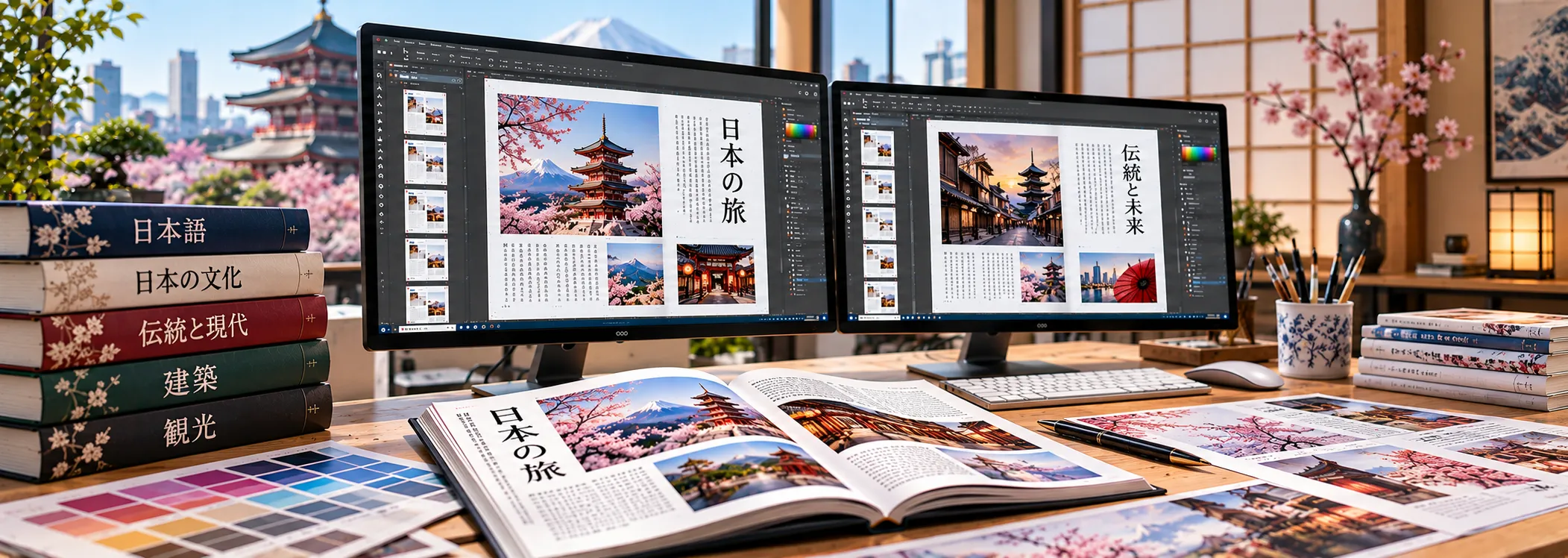
Japanese DTP Services for Print, Digital, and Localized Content
Japanese is one of the most demanding languages to typeset. Mixed scripts, vertical reading direction, strict line-breaking rules and ruby annotations mean a translated file cannot simply be dropped into an English layout. Our Japanese DTP services give you layouts that look and read as if they were designed in Japan from the start, ready for print or screen.
What Are Japanese DTP Services?
Japanese DTP services cover the desktop publishing work that turns translated Japanese text into a finished, professional layout. That includes typesetting the text, adapting the design of the source file, handling fonts, formatting vertical or horizontal text, placing images and preparing files for print or digital delivery.
It is different from translation. A translator delivers the Japanese words. A Japanese DTP specialist makes those words fit the page correctly, follow Japanese typographic conventions and match the original design intent. If you already have your content translated, we handle the layout. If you need both, we can coordinate the work with your localization team so nothing is lost between text and design.
Why Japanese Typesetting Needs Specialist Handling
Generic DTP workflows are built around Latin text. Japanese breaks several of those assumptions at once:
- Multiple scripts in one line. Kanji, hiragana, katakana and Latin characters, numerals and symbols are mixed together, and each needs the right font, spacing and alignment.
- Line-breaking rules (kinsoku shori). Certain characters cannot start or end a line. Getting this wrong is immediately visible to a Japanese reader.
- Character spacing (mojikumi). Punctuation, brackets and mixed text follow defined spacing rules, commonly based on JIS X 4051, that differ from Western kerning.
- Vertical and horizontal text. Japanese can run top-to-bottom, right-to-left (tategaki) or left-to-right (yokogaki). Numbers, Latin words and short phrases in vertical text may need tate-chu-yoko treatment.
- Ruby (furigana). Small reading aids above or beside kanji must align cleanly without disrupting line spacing.
- Font selection. Mincho and Gothic families carry different tones, and licensing, embedding and glyph coverage all need checking.
- Text length and density changes. Japanese text often takes fewer characters than English but needs more line height and careful density control, so text boxes, tables and captions rarely carry over unchanged.
Our team works with these rules every day, so your file is checked for typography, not only for text that “fits.”
Our Japanese DTP Services
Japanese Typesetting and Layout
We typeset Japanese text in Adobe InDesign and recreate or adapt the original layout so hierarchy, spacing and readability are preserved. We apply proper paragraph composition, line-break control, punctuation spacing and font pairing for both horizontal and vertical layouts. See our InDesign DTP Services for more on our workflow.
English to Japanese Layout Adaptation
When you send English source files with Japanese translations, we adapt the design to the new language. This covers text reflow, headline and callout adjustments, table and chart updates, page-count changes, and converting layouts to right-to-left page progression when a vertical Japanese publication requires it.
Vertical Text (Tategaki) DTP
Books, magazines, manga-adjacent editorial content, certificates and cultural publications often use vertical text. We handle vertical composition, rotated and upright characters, tate-chu-yoko for numbers and short Latin strings, vertical punctuation and ruby placement.
Ruby and Furigana Formatting
We set ruby for educational materials, children’s content, legal and technical terms and reference works, using group, mono or jukugo ruby as your content requires and keeping line spacing consistent.
Word and PowerPoint Japanese DTP
Not every project lives in InDesign. We format Japanese content in Microsoft Word and PowerPoint, including fonts that behave correctly on Windows and Mac, East Asian language settings, line-break options and editable templates your team can keep using. See Word & PowerPoint DTP Services.
PDF to InDesign Conversion for Japanese Files
If you only have a flattened PDF, we rebuild it as an editable InDesign file with live Japanese text, correct fonts and organized styles. See PDF to InDesign Conversion Services.
Image and Graphic Localization
Diagrams, screenshots, infographics and packaging art often contain embedded text. We replace it with Japanese while matching the original look. See Image Localization Services.
Print-Ready File Preparation for Japan
We prepare files to the standards Japanese printers expect, including trim marks, bleed, colour mode, font outlining or embedding, and PDF/X output as required. Our Print-Ready File Preparation process covers the checks before delivery.
Content We Typeset in Japanese
- User manuals and technical documentation
- Product catalogs, brochures and datasheets
- Corporate reports, presentations and training materials
- Books, e-books and academic publications
- Marketing collateral, packaging and labels
- Medical, pharmaceutical and regulatory documents
- E-learning and instructional content
- Software and hardware guides
Formats and Tools We Work With
- Adobe InDesign (INDD, IDML) and InCopy
- Adobe Illustrator and Photoshop for graphics and packaging
- Microsoft Word, PowerPoint and Excel
- Adobe FrameMaker for technical documentation
- PDF, including scanned and flattened files
- Print and digital outputs: PDF/X, interactive PDF, EPUB-ready layouts
Send us whatever source files you have. If we need packages, links or fonts, we will tell you at the start. For more on working with or without originals, see Multilingual Typesetting Services.
Our Japanese DTP Process
- Source file review. We check your files, the translation, fonts, links and the target output so there are no surprises.
- Typography and font plan. We confirm horizontal or vertical setting, font families, ruby needs and any style guide or glossary from your team.
- Layout and typesetting. We place the Japanese text, adapt the design and build clean styles for future updates.
- Quality checks. We review line breaks, punctuation spacing, character consistency, numerals, images, page flow and missing or substituted glyphs.
- Review round. You or your Japanese reviewer can send corrections. We apply them promptly and re-check the affected pages.
- Final delivery. You receive print-ready or digital files, plus the editable package when requested.
Why Choose Global Digital DTP for Japanese Projects
- Language-aware production. Typography rules are applied by people trained in multilingual DTP, not left to software defaults.
- Built for localization workflows. We work alongside translators, localization managers and agencies, and can match your style guides and file naming.
- Consistent, editable files. Styles and structure are organized so later updates are fast and cheaper.
- Scales with your volume. From a single brochure to ongoing multi-document programs, including DTP outsourcing for agencies and in-house teams.
- Part of a wider language offering. Japanese projects often sit beside Chinese, Korean and other languages. Our CJK DTP Services and Multilingual DTP teams keep multi-language releases aligned.
Frequently Asked Questions About Japanese DTP Services
What do Japanese DTP services include?
They include typesetting translated Japanese text, adapting the layout of the source file, formatting vertical or horizontal text, ruby, fonts, image text replacement and preparing final files for print or digital use.
Do you translate the content as well?
Our focus is DTP and layout. You can provide translated text, or we can work with your translation team so the Japanese content flows directly into the design. Tell us your setup in the quote request and we will advise on the best approach.
Can you set Japanese text vertically?
Yes. We handle vertical (tategaki) composition, including right-to-left page progression, tate-chu-yoko, vertical punctuation and ruby.
Which file formats do you accept?
We accept InDesign, Illustrator, Word, PowerPoint, Excel, FrameMaker and PDF files. If you only have a PDF, we can rebuild it as an editable layout.
Do I need to send the original design files?
Originals are ideal because they preserve the exact design. If they are not available, we can recreate the layout from a PDF or printed reference.
How do you handle fonts?
We select Japanese fonts to suit the content and tone, check licensing and embedding, and avoid font substitution. If your brand has specific Japanese fonts, we use them.
Can you match our Japanese style guide or glossary?
Yes. Share style rules for typography, terminology, numerals or punctuation and we will apply them across the project.
How long does a Japanese DTP project take?
Timelines depend on page count, complexity, file condition and review rounds. Send your files with the deadline for a clear estimate.
Do you work with agencies?
Yes. We support localization agencies and in-house localization teams with white-label and recurring production.
How much do Japanese DTP services cost?
Pricing depends on the file type, volume, layout complexity, vertical text or ruby requirements and turnaround. Request a free quote for project-specific pricing.
Get a Quote for Japanese DTP Services
Tell us about your files, page count, content type and deadline.
We will respond with a clear scope and quote for your Japanese DTP project.
Email: info@globaldigitaldtp.com | Phone/WhatsApp: +91 8826707501