Multilingual OCR Services for Scanned Documents, PDFs and Images
Scanned PDFs, image-only files and printed pages are hard to translate, edit or reuse.
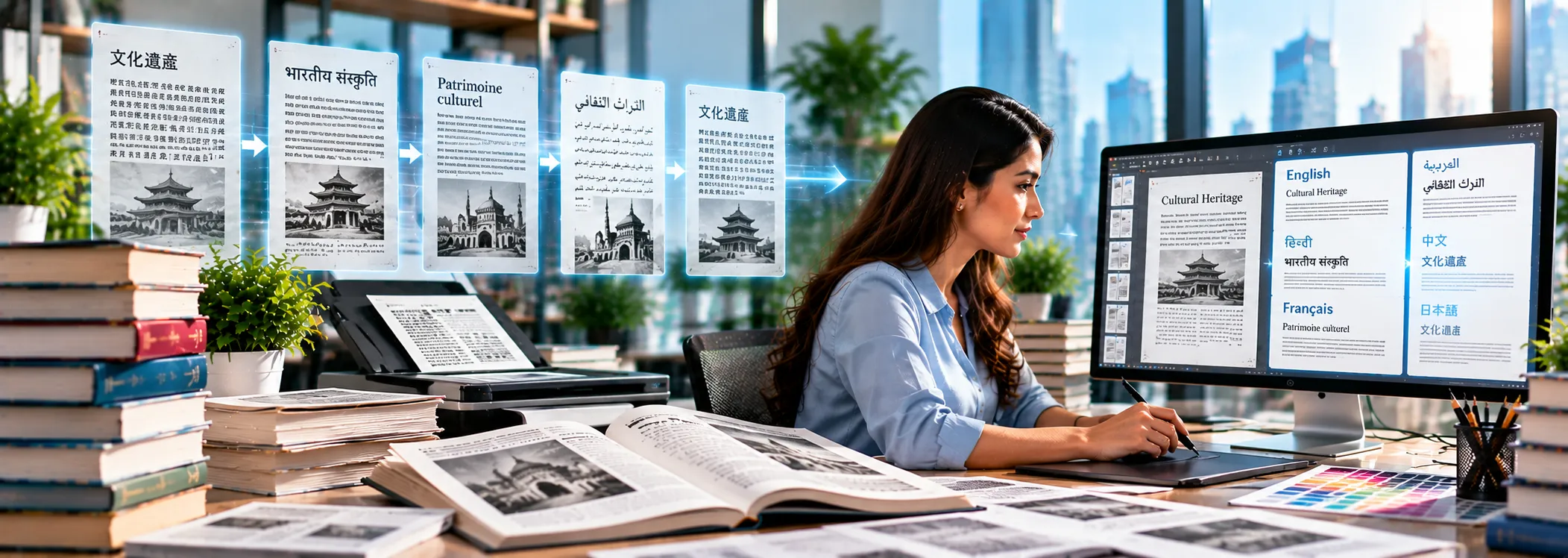
Our multilingual OCR services convert them into clean, editable, searchable files in more than 100 languages and scripts, including Arabic, Hebrew, Chinese, Japanese, Korean, Thai, Hindi and Cyrillic-based languages. A trained language specialist reviews every file, and we rebuild the layout so the result is ready to translate, typeset or publish.
What Are Multilingual OCR Services?
OCR (optical character recognition) turns text in a scan, photo or image-only PDF into text a computer can read and edit. Basic OCR tools work reasonably well on clean English text. They struggle with accented characters, right-to-left scripts, complex scripts, vertical text, mixed-language pages and poor-quality originals.
Multilingual OCR services combine language-aware OCR engines with human proofreading and desktop publishing (DTP). The output is an accurate text layer and a usable file, not a block of garbled characters.
Global Digital DTP handles the full chain: recognition, proofreading, layout reconstruction and delivery in the format your next step needs.
Why Standard OCR Fails on Multilingual Documents
Off-the-shelf OCR tools often produce errors that look small but cause expensive rework later:
- Wrong language detection. Pages that mix languages, such as a French manual with English product names or a bilingual form, are read with the wrong dictionary.
- Lost diacritics and special characters. Accents, tone marks and ligatures are dropped or swapped, which changes meaning.
- Broken right-to-left text. Arabic, Hebrew, Persian and Urdu can come out reversed, disconnected or in the wrong reading order.
- Complex scripts misread. Devanagari, Thai, Tamil, Bengali and similar scripts depend on character combinations that generic engines often break.
- CJK errors. Chinese, Japanese and Korean pages may include vertical text, furigana, similar-looking characters and mixed scripts.
- Scrambled layouts. Tables, columns, headers, footnotes and captions are flattened into a single stream of text.
Our process is built to catch and fix these problems before the file reaches you or your translators.
Our Multilingual OCR Services
OCR for Scanned PDFs and Image-Only Files
We convert scanned PDFs, TIFFs, JPGs and PNGs into editable Word, InDesign, Excel, text or searchable PDF files. This is the right option when you have only a scan and need to translate, update or republish the content.
Document Digitization and Archiving
Legal files, contracts, certificates, technical records, training material and historical documents can be converted into searchable, text-based archives. We keep the original’s structure so the digital version is usable, not just readable.
OCR with Layout Reconstruction
Accurate text is only half the job. We rebuild headings, columns, tables, bullet lists, headers and footers, and page numbering to match the source. Where fidelity matters, we match fonts, styles and spacing, and reproduce graphics.
OCR for Translation and Localization Projects
Translation teams get clean, segment-ready source text instead of copying from images. This cuts translation time, reduces errors and helps translation memory tools work properly. Our multilingual DTP team can then place the translated text back into the original design.
Handwriting and Low-Quality Source Material
Faded print, skewed scans, stamps, photocopies and fax-quality pages need extra care. We clean up images where possible and apply manual verification to difficult areas. Handwriting is assessed case by case, so send a sample and we will tell you what is realistic.
Image Text Extraction
Text embedded in screenshots, infographics, product photos, diagrams and signage can be extracted for translation and then rebuilt. See our image localization services for the full workflow.
Languages and Scripts We Support
We work with a wide range of languages and writing systems, including:
- Latin-script languages: English, Spanish, French, German, Italian, Portuguese, Dutch, Polish, Turkish, Vietnamese and many more
- Cyrillic: Russian, Ukrainian, Bulgarian, Serbian and others
- Right-to-left: Arabic, Hebrew, Persian (Farsi), Urdu
- East Asian: Simplified and Traditional Chinese, Japanese, Korean
- South and Southeast Asian: Hindi, Bengali, Tamil, Telugu, Gujarati, Marathi, Thai, Khmer, Burmese and more
- Other scripts: Greek, Armenian, Georgian and additional languages on request
Don’t see your language listed? Ask us. We can usually arrange a qualified reviewer.
How Our Multilingual OCR Process Works
- File and language review. We check your files, identify every language and script on the page, and flag quality problems such as low resolution, skew or damage.
- Image preparation. We straighten, denoise and enhance scans where needed to improve recognition.
- Language-specific OCR. We apply the right engine and language settings for each script and set up mixed-language pages correctly.
- Human proofreading. A reviewer who reads the language compares the output with the source and corrects errors in characters, diacritics, numbers, punctuation and reading order.
- Layout and formatting. We rebuild the document structure, including tables, columns and styles, in your chosen format.
- Final quality check and delivery. We run a last check against the original and deliver your files, with a short note on anything that was illegible or ambiguous in the source.
Output Formats
We deliver in the format that fits your next step:
- Editable Word (DOCX)
- Adobe InDesign (INDD / IDML)
- Excel (XLSX) for tabular data
- Searchable PDF
- PowerPoint (PPTX)
- Plain text, HTML or XML
- Other formats on request
Who Uses Our Multilingual OCR Services
- Translation agencies and language service providers who receive scanned or image-only source files
- Legal and compliance teams digitizing contracts, filings and certificates
- Manufacturers and engineering firms working with legacy manuals, specifications and technical drawings
- Publishers and educators converting printed books, course material and catalogs
- Life sciences and healthcare organizations updating labeling, instructions for use and regulatory documents
- Government and NGOs digitizing archives and records in multiple languages
Why Choose Global Digital DTP
OCR and DTP in one place. Most OCR vendors hand you raw text. We also rebuild the layout, so you don’t need a second vendor to make the file usable.
Language-aware quality control. Every file is reviewed by someone who understands the script, which is what separates usable output from text that merely looks right.
Built for translation workflows. We prepare files so translators, CAT tools and publishing teams can use them immediately.
Clear communication. If a section of the source is unreadable or ambiguous, we flag it rather than guess.
Confidential handling. Your documents are handled securely, and we are happy to sign an NDA before you send files.
Multilingual OCR Services FAQ
What is the difference between OCR and multilingual OCR?
OCR recognizes text in images. Multilingual OCR does this across many languages and scripts, including right-to-left and complex scripts, and handles pages that mix several languages.
How accurate is multilingual OCR?
Accuracy depends on the language, the print quality and the layout. Clean, modern print can reach very high accuracy. Faded, skewed or handwritten material is harder. Human proofreading brings the final output to a reliable standard, and we tell you in advance if your source quality is a risk.
Can you OCR a document that contains more than one language?
Yes. We configure each section for the correct language so a single page can include, for example, English, Arabic and Chinese.
Can you keep the original layout?
Yes. We reconstruct headings, columns, tables, lists and styling to match the source as closely as the format allows.
Which file types can you work with?
Scanned PDFs, image-only PDFs, TIFF, JPG, PNG, and photos of printed pages. If you have another format, send it and we will confirm.
Can you OCR handwritten documents?
It depends on legibility and language. Send a sample and we will give you an honest assessment.
Do you offer OCR as part of translation or localization projects?
Yes. We can prepare source files, support your translators and place the translated text back into the finished layout.
How do I get a price?
Send us your files, languages, page count and preferred output format through our quote form. We will reply with a clear estimate and timeline.
Get Accurate, Editable Files From Any Scan
Send us a sample of your scanned documents, and we will show you what clean multilingual OCR looks like on your own files.
Email: info@globaldigitaldtp.com | Phone/WhatsApp: +91 8826707501