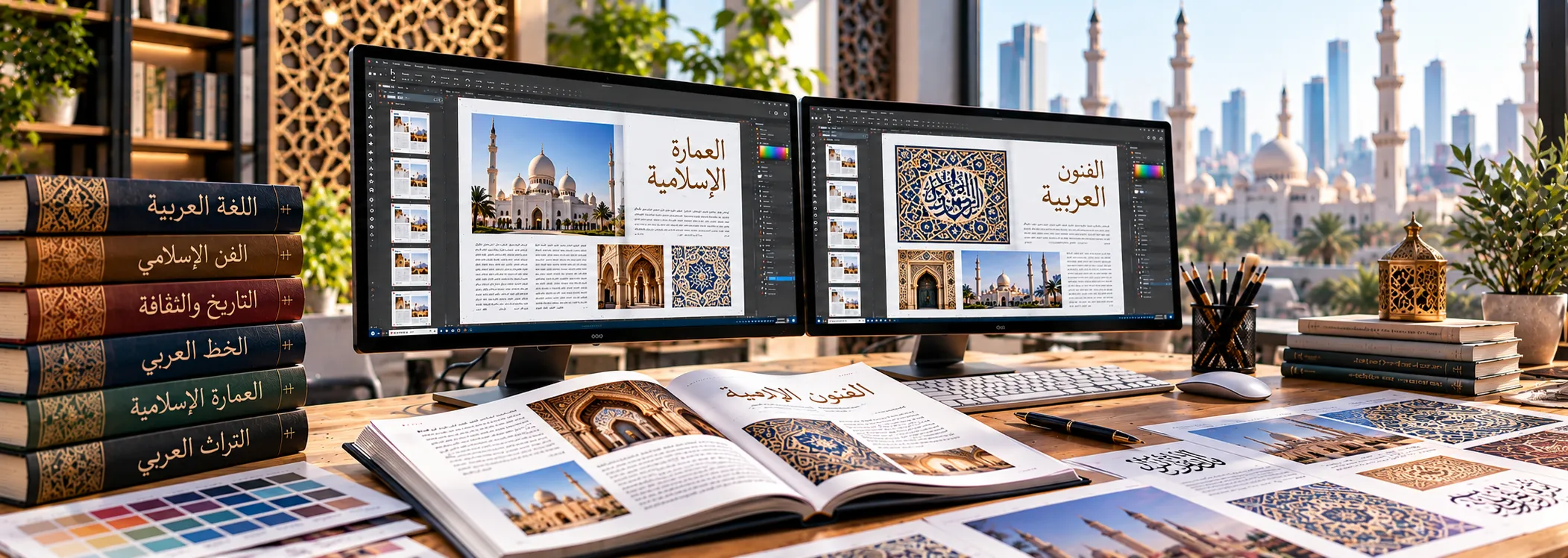
Arabic DTP Services for Accurate Right-to-Left Layout in Print and Digital
Our Arabic DTP services turn translated Arabic text into finished, publication-ready files. We rebuild your English or multilingual layouts for right-to-left reading, set Arabic type correctly, and deliver editable InDesign, Word, PowerPoint and PDF files that look native, not converted.
Arabic is not a find-and-replace job. Letters connect and change shape, pages flow from right to left, and numbers, English terms and punctuation have to sit correctly inside Arabic lines. Our desktop publishing team handles these details so your Arabic documents are ready for print, web, or app use.
What Our Arabic DTP Services Include
We cover the full layout side of an Arabic project:
- Arabic typesetting of translated text in InDesign, Word, PowerPoint and other formats
- RTL layout adaptation, including mirrored page structure, reversed reading order and flipped alignment
- Bilingual and multilingual layouts that combine Arabic with English or other languages
- Font selection and replacement with Arabic typefaces that match your brand and support the full character set
- Tables, charts and diagrams rebuilt for right-to-left reading
- Headers, footers, page numbers and tables of contents set up for RTL documents
- PDF and print-ready output with correct fonts, bleeds and export settings
- Arabic PDF to editable file conversion when you only have a locked PDF
If your project also needs other languages, see our multilingual DTP and multilingual typesetting services.
Why Arabic Layout Needs Specialist DTP
Most layout problems in Arabic files come from software defaults and from treating Arabic like a left-to-right language. These are the issues our team checks and fixes on every job.
Connected letter shaping and ligatures
Arabic letters take different forms depending on their position in a word: initial, medial, final or isolated. They also join into ligatures. If the wrong font or text engine is used, letters appear disconnected, reversed or replaced with boxes. We use Arabic-capable fonts and the correct text composition settings so every word renders as it should.
Right-to-left flow and mirrored layouts
Arabic documents are read from right to left, and books and brochures open from the opposite side. That affects far more than text alignment. Page order, binding side, columns, bullet positions, image placement, icons with direction, and navigation elements often need to be mirrored. We rebuild these elements deliberately rather than flipping the whole page.
Mixed-direction text
Arabic content frequently contains English product names, abbreviations, URLs, email addresses, part numbers and numerals. These run left to right inside a right-to-left sentence, and punctuation around them can jump to the wrong side. We check bidirectional text line by line and correct ordering, spacing and punctuation.
Diacritics, kashida and justification
Some Arabic content uses diacritics (tashkeel), such as educational materials, religious texts and children’s books. These marks must stay attached to the right letters and remain legible at small sizes. Justified Arabic text can also use kashida, the elongation of connecting strokes, instead of stretching word spaces. We apply justification carefully so text blocks look even without distorting words.
Numerals and punctuation
Arabic content may use Western numerals (1, 2, 3) or Eastern Arabic-Indic numerals (١، ٢، ٣), depending on the region, industry and client preference. Arabic also has its own comma, semicolon and question mark. We follow your style guide, or help you choose a consistent convention, and apply it across the whole document.
Font choice and legibility
Arabic typefaces differ in style, weight range and glyph coverage. A font that looks good in a heading may be hard to read in small body text, and some Latin brand fonts have no Arabic equivalent. We recommend suitable Arabic fonts, match weights and sizes to your Latin design, and check licensing for commercial use before we embed anything.
Document Types We Format in Arabic
Our Arabic DTP services support content for business, education, publishing and technical communication:
- Brochures, flyers and catalogs
- User manuals and technical documentation
- Corporate reports and presentations
- Training and e-learning materials
- Books, textbooks and e-books
- Legal, financial and regulatory documents
- Packaging, labels and inserts
- Forms, tables and data-heavy documents
- Marketing collateral and sales decks
- Medical and pharmaceutical leaflets
For long-form publishing projects, see our Book DTP & Typesetting Services. For Office-based documents, see Word & PowerPoint DTP Services.
Source Files or No Source Files
You can start from almost any material:
- You have the original InDesign, Word or PowerPoint files. We duplicate the layout and rebuild it with the Arabic text, keeping your styles, grids and brand elements.
- You only have a PDF. We can recreate the document from scratch or use PDF to InDesign conversion to produce editable files.
- Your source is a scan or image. Our multilingual OCR services can extract the text before layout begins.
- Your artwork contains text in images. Our image localization services can handle the Arabic versions of graphics, screenshots and diagrams.
Our Arabic DTP Process
- Project review. We look at your source files, the translated Arabic text, fonts, brand guidelines and output requirements before we start.
- Technical setup. We prepare the file for Arabic composition, with the right text engine, fonts, paragraph direction and styles.
- Layout and typesetting. We place the Arabic text, mirror the layout where needed and adjust spacing, leading and alignment for Arabic reading.
- Bidirectional and detail checks. We review mixed English and Arabic text, numerals, punctuation, hyphenation-free line breaks, diacritics and special characters.
- Visual QA. We compare the finished pages against the source for layout consistency, missing content, overflows and font substitution.
- We provide the files you need: packaged InDesign files, editable Office documents, print-ready PDFs or web-ready PDFs.
- If your Arabic reviewer sends corrections, we update the files and re-check the affected pages.
Quality Checks Before Delivery
Every Arabic file goes through a layout-focused quality check that covers:
- Correct letter joining and no broken or reversed words
- Right-to-left page order, column order and alignment
- Consistent numerals and punctuation
- English terms, URLs and numbers placed correctly inside Arabic text
- Tables, charts and lists reading in the right direction
- Cross-references, page numbers, tables of contents and indexes
- No missing fonts, overset text or text overflow
- Images, captions and icons matching the mirrored layout
- Print specifications, color and PDF settings
Note that DTP works from your approved translation. Linguistic review remains with your translators and reviewers, but we flag anything at layout level that looks wrong, such as unexpected characters or inconsistent terminology across pages.
Software and File Formats
We work with the tools used in professional Arabic publishing:
- Adobe InDesign (see our InDesign DTP Services)
- Adobe Illustrator and Photoshop for graphics and image files
- Microsoft Word, PowerPoint and Excel
- Adobe Acrobat and PDF workflows
- FrameMaker and other technical documentation tools, on request
- Print-ready, web-optimized and accessible PDF output
We also prepare files for press and digital distribution. See Print-Ready File Preparation for details.
Bilingual Arabic and English Layouts
Many projects need Arabic and English side by side. Depending on your use case, we can set up:
- Separate Arabic and English editions with matching design
- Facing-page layouts, with English on one side and Arabic on the other
- Dual-column layouts with synchronized content
- Back-to-back publications, where one language opens from each cover
- Multilingual packs where Arabic sits alongside other languages
We keep content aligned, fonts balanced and visual weight consistent, so neither language looks like an afterthought.
Who We Work With
Global Digital DTP supports:
- Language service providers that need a reliable DTP partner for Arabic work
- Marketing and design agencies localizing campaigns for Arabic-speaking markets
- Publishers producing Arabic editions
- Corporate teams localizing manuals, reports and training materials
- Manufacturers preparing product documentation for Middle Eastern and North African markets
If you outsource regularly, our DTP outsourcing services are designed for ongoing volume.
What to Send for a Quote
To get an accurate quote quickly, send us:
- Source files (InDesign packages, Word, PowerPoint, or PDFs)
- The translated Arabic text, if it is already available
- Page count, file type and target output (print, web or both)
- Preferred fonts, brand guidelines and any style guide for numerals and punctuation
- Your deadline and whether this is a one-off or recurring project
Request a Free Quote and we will respond with a clear scope, timeline and price.
Arabic DTP Services FAQ
What are Arabic DTP services?
Arabic DTP services are desktop publishing services that format Arabic text and layouts for print and digital publication. They include right-to-left typesetting, mirrored page design, font selection, bidirectional text handling and the creation of print-ready or web-ready files.
Why can’t I just paste Arabic text into my English layout?
Pasting Arabic into a left-to-right layout usually causes disconnected letters, reversed word order, misplaced punctuation and broken alignment. Arabic needs the right fonts, text engine settings and layout adjustments to display correctly, which is what Arabic DTP provides.
Can you work from the original English InDesign files?
Yes. Sending the original InDesign package is the best starting point because it lets us keep your styles, grids and design intact while we rebuild the layout in Arabic.
Can you convert an English PDF into an Arabic layout?
Yes. If you do not have the source files, we can recreate the layout or convert the PDF into an editable file first, then set the Arabic text.
Do you handle Arabic and English in the same document?
Yes. We regularly set bilingual and multilingual documents, including facing-page, dual-column and back-to-back formats, with mixed-direction text checked carefully.
Which Arabic fonts do you use?
We select fonts based on your brand, the document type and legibility needs. If your brand font has no Arabic version, we recommend suitable options and confirm licensing before delivery.
Do you offer Arabic translation?
Our service focuses on layout and typesetting of approved Arabic text. If you need translation as well, tell us when you request a quote and we will discuss how to handle it.
What file formats will I receive?
Typically you will receive the packaged InDesign files, editable Office documents where relevant, and print-ready or web-optimized PDFs. Tell us what your printer or platform requires and we will match it.
Related Services
- RTL DTP Services for Arabic, Hebrew, Persian, Urdu and other right-to-left languages
- Multilingual DTP for projects that cover several languages
- Multilingual Typesetting Services
- InDesign DTP Services
- PDF to InDesign Conversion Services
- Localization Services
Start Your Arabic DTP Project
Send us your files and requirements, and our team will review them and reply with a clear quote and timeline.
Your Arabic documents deserve a layout that reads naturally, prints cleanly and matches the quality of your original.
Email: info@globaldigitaldtp.com | Phone/WhatsApp: +91 8826707501