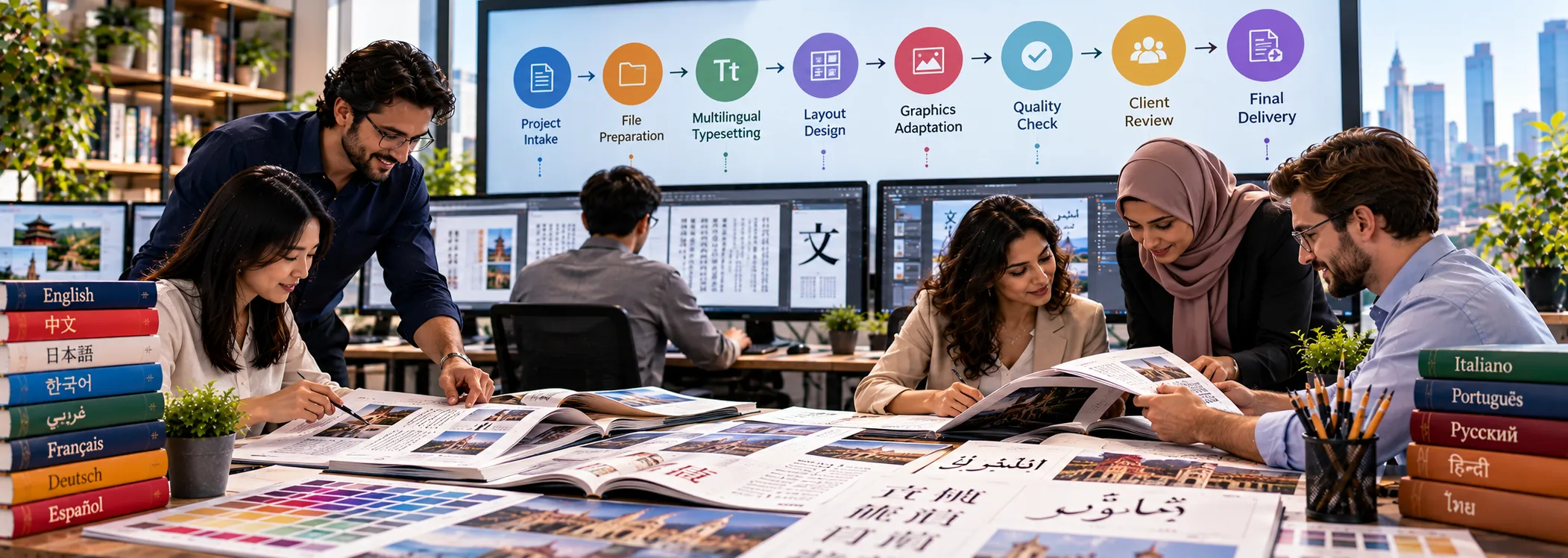
Multilingual DTP Workflow: From Source Files to Print-Ready Translations
A reliable multilingual DTP workflow is what separates a translated document that simply exists from one that looks professionally published in every language. Translation changes text length, direction, fonts and line breaking. Without a controlled process, those changes break layouts, split words in the wrong places and put the wrong glyphs on the page.
At Global Digital DTP, we use a structured multilingual DTP workflow built for documents that move between many languages, scripts and output formats. It covers everything from source file audit to final print and digital delivery, so your team gets consistent files without chasing corrections.
What Is a Multilingual DTP Workflow?
A multilingual DTP workflow is the end-to-end process of taking translated text and placing it back into a designed layout, with the right fonts, direction, spacing and formatting for each target language. It sits between translation and publishing. It also protects the work done on both sides.
In practice, the workflow answers a few questions every localization project faces:
- How do we get translated text into the layout without losing styles or structure?
- How do we handle text expansion, text contraction and different line-breaking rules?
- How do we support right-to-left, Asian and Indic scripts correctly?
- How do we check every language version before it goes to print or online?
A documented process answers these once, then repeats the answers reliably across every language and every project.
Why a Defined Workflow Matters for Translated Documents
Multilingual layout problems rarely come from one big mistake. They come from small, repeated gaps: a missing font, a style that was never set up for another script, a text frame that cannot hold longer text. A defined multilingual DTP workflow closes those gaps early.
Common Problems a Workflow Prevents
- Text overflow and cut-off copy when languages such as German, Finnish or Spanish run longer than English.
- Broken scripts where Arabic letters appear disconnected or Hindi conjuncts render incorrectly.
- Wrong direction where Arabic, Hebrew, Urdu or Persian pages are not mirrored properly.
- Missing glyphs and fallback fonts that show boxes or mismatched characters.
- Inconsistent styling between language versions of the same document.
- Late-stage rework that pushes launch dates and raises costs.
Our 9-Step Multilingual DTP Workflow
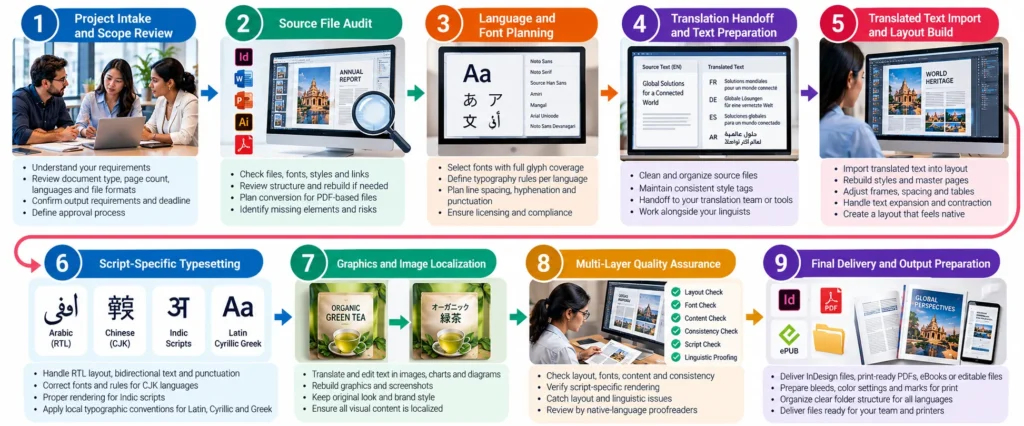
Every project follows the same core steps. We adjust the depth of each step to your file types, language mix and deadline.
Step 1: Project Intake and Scope Review
We start by understanding what you need. We review the document type, page count, target languages, file formats, output requirements and deadline. We also confirm who approves final files on your side.
This step sets the scope, flags risks early and gives you a clear plan before any layout work begins.
Step 2: Source File Audit
We check the source files in detail. For InDesign this means linked images, fonts, styles, master pages, layers and any scripts or plug-ins in use. For Word, PowerPoint, Illustrator or PDF-based projects, we check the structure and what needs rebuilding.
When only a PDF is available, we plan a rebuild. Our PDF to InDesign conversion service restores an editable layout so translation and formatting can continue properly.
Step 3: Language and Font Planning
Before layout starts, we plan the fonts and typography for each target language. We select fonts with full glyph coverage, confirm licensing with you where needed, and define rules for each script.
This includes line spacing for scripts with tall or deep glyphs, hyphenation and line-breaking rules, punctuation conventions, numeral styles and typographic standards for each market.
Step 4: Translation Handoff and Text Preparation
Good files make good translation. We prepare the source for linguistic work by cleaning the structure, organizing text flow and keeping style tags consistent. Depending on your setup, the text goes to your translation team or vendor as exported files, or the workflow connects with your existing translation tools.
Our team works alongside your linguists. If you need translation as well, see our localization services.
Step 5: Translated Text Import and Layout Build
Once translations are ready, we place them into the layout. We rebuild styles, master pages and text flow for each language so every version stays faithful to the original design while respecting the language itself.
We resize frames, adjust spacing and rework tables, captions and call-outs to handle expansion and contraction. The aim is a layout that reads as if it were designed for that language from the start.
Step 6: Script-Specific Typesetting
This is where multilingual projects succeed or fail. Each script family needs its own handling.
- Right-to-left languages: full page and text mirroring, correct handling of mixed-direction text, numbers and punctuation, and bidirectional layout checks. See our RTL DTP services, including Arabic and Urdu
- Chinese, Japanese and Korean: correct fonts, vertical or horizontal composition, line-breaking rules and punctuation handling. See our CJK DTP services.
- Indic scripts: correct conjunct and ligature rendering, matra placement and font selection. See our Indic DTP services.
- Latin, Cyrillic and Greek languages: accent handling, hyphenation dictionaries and local typographic conventions.
You can see the full list on our languages we support page.
Step 7: Graphics and Image Localization
Text inside images, charts, diagrams and screenshots often needs translating too. We rebuild or replace these elements so every language version is complete. Where images need new text, our image localization services handle the editing while keeping the original look.
Step 8: Multi-Layer Quality Assurance
Quality assurance is built into the workflow, not added at the end. Each language version goes through checks designed to catch layout and linguistic issues.
- Layout checks: overflow, overset text, widows and orphans, alignment, spacing and table integrity.
- Font checks: missing glyphs, fallback fonts, correct weights and embedding.
- Content checks: comparison against the translated text, numbering, cross-references, headers, footers and tables of contents.
- Consistency checks: matching styles, colors and structure across all languages.
- Script checks: direction, shaping, ligatures and punctuation for each script.
- Linguistic proofing: reviewed in context, ideally by a native-language reviewer, so errors that only appear in layout are caught.
Step 9: Final Delivery and Output Preparation
We deliver files in the formats you need: packaged InDesign files with fonts and links, print-ready PDFs, web or interactive PDFs, e-book formats or editable source files. For print, we prepare bleeds, color settings and marks. See our print-ready file preparation service for details.
Every language is delivered in a clear, organized folder structure, so your team and printers can find the right file quickly.
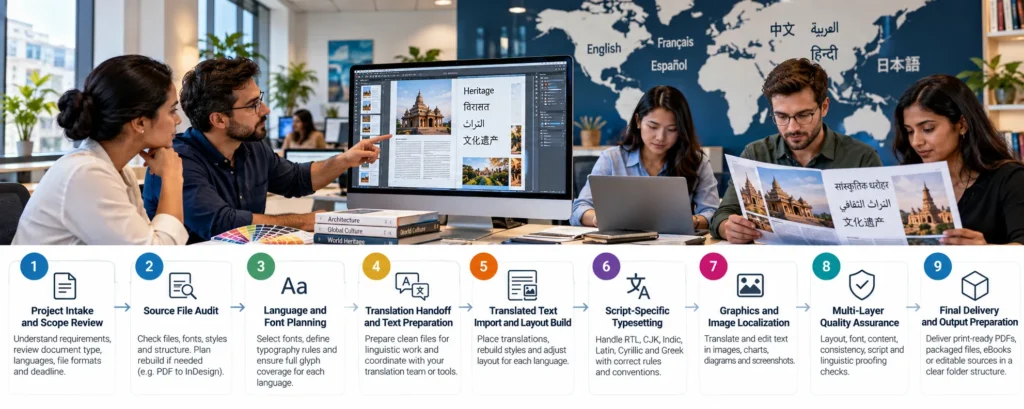
Multilingual DTP Workflow by Software
The workflow stays consistent across tools, while the technical details change.
Adobe InDesign
InDesign is the standard for complex multilingual documents. We use paragraph, character and object styles, master pages and the World-Ready and Middle Eastern composers where needed. See our InDesign DTP services.
Microsoft Word and PowerPoint
Office files need careful handling of styles, text boxes and embedded objects, especially for non-Latin scripts. See our Word and PowerPoint DTP services.
Illustrator, Photoshop and Other Design Files
Brochures, packaging and graphics often need text edits on layered files. We rebuild or edit them while protecting the design.
PDF-Only Source Files
When you only have a PDF, we reconstruct the layout first, then follow the standard workflow. Scanned files can be processed through OCR services and multilingual OCR before rebuilding.
Workflow Variations by Project Type
Books and Long-Form Publications
Books need consistent styles, running heads, pagination, indexes and cross-references. Our book DTP and typesetting services apply the workflow at volume, with templates reused across languages.
Technical Manuals and User Guides
These documents are often updated. We set up templates and style structures so future revisions are faster and cheaper.
Marketing Materials and Brochures
Design impact matters most here. We adapt layouts creatively while keeping brand rules intact.
Legal, Financial and Regulated Documents
Accuracy and consistency come first. We apply stricter comparison and verification steps.
E-Learning and Training Content
We handle text in slides, graphics and course materials, keeping structure aligned across versions.
How We Handle Text Expansion and Contraction
Translated text rarely matches the original length. As a general pattern, many European languages run longer than English, while Chinese, Japanese and Korean often run shorter. We plan for this from the start.
- Flexible text frames and style-based spacing
- Adjusted font sizes and leading within brand limits
- Reworked tables, columns and call-outs
- Layout reviews in context before approval
Where layouts truly cannot hold the text, we flag it early so your team can decide whether to edit the copy or adjust the design.
Tools and Quality Controls We Use
Our process combines professional layout software with structured checks.
- Adobe Creative Cloud applications for layout and graphics
- Preflight profiles to catch technical issues before delivery
- Style-based templates that keep languages consistent
- Checklists for each script family
- Version control and clear file naming for multi-language projects
Working With Your Existing Translation Process
We do not ask you to change how your linguists work. We fit around your process.
- Translation delivered as Word files, spreadsheets, XLIFF or exported text
- Coordination with your translation vendor, if you use one
- Translation memory and glossary alignment where relevant
- In-context review rounds so linguists can check final layouts
This keeps the handoff between translation and DTP clean, and avoids the rework that comes from layouts built on unfinished text.
Turnaround, Revisions and Communication
Speed matters in multilingual projects, especially when many languages ship together.
- Clear timelines agreed at intake, per language and per phase.
- Parallel production so several languages progress at once.
- Structured revision rounds with consolidated feedback.
- Direct communication with a named contact for your project.
The workflow is designed to keep revision rounds short by getting the foundations right early.
Why Choose Global Digital DTP for Your Multilingual DTP Workflow
- Script expertise: experience across RTL, CJK, Indic and Latin-based languages.
- A repeatable process: the same quality steps on every project, in every language.
- Software depth: strong command of InDesign and other professional tools.
- Built-in QA: checks at each stage, not only at the end.
- Flexible engagement: one-off projects, ongoing programs and outsourced production. See our DTP outsourcing services.
- Clear communication: straightforward timelines, files and feedback.
Learn more about our team on the About Us page.
Who This Workflow Is For
- Localization and translation agencies that need a dependable DTP partner
- Publishers releasing titles in several languages
- Manufacturers and technology companies translating manuals and guides
- Marketing teams adapting campaigns and collateral
- Legal, financial, medical and educational organizations with regulated content
- Design studios that need multilingual capacity without hiring in-house
Multilingual DTP Workflow Checklist: What to Prepare Before You Start
A little preparation speeds up the whole process. Where you can, provide:
- Editable source files (for example INDD with the package folder, DOCX, PPTX, AI, PSD)
- Fonts and linked images, or a note on which fonts are required
- Target language list and any regional variants
- Brand guidelines and any style guide
- Output requirements: print, web, e-book or all
- Glossaries or translation memory, if used
- Reference files from previous versions
- Deadline and review contacts
Missing something? That is fine. We audit what you have and tell you what is needed.
Frequently Asked Questions About the Multilingual DTP Workflow
What is a multilingual DTP workflow?
It is the structured process of placing translated text into designed layouts, with correct fonts, direction and formatting for each language, and checking every version before delivery.
How is multilingual DTP different from regular DTP?
Regular DTP formats one document in one language. Multilingual DTP manages many language versions at once, handling text expansion, different scripts, right-to-left direction and consistency across all versions.
When in the translation process does DTP happen?
DTP normally happens after translation is final, though source file preparation starts before translation. Preparing early avoids delays and rework.
Can you work from PDF files?
Yes. We can rebuild a PDF into an editable layout first. Scanned PDFs may need OCR before the rebuild.
Which languages can you handle?
We work across right-to-left, CJK, Indic and many Latin-based and other scripts. Visit our languages we support page for details.
Do you handle right-to-left languages like Arabic and Urdu?
Yes. This includes full layout mirroring, correct shaping, mixed-direction text and number handling.
How do you manage text expansion?
We plan flexible layouts, adjust spacing and styles, and review each language in context. If copy cannot fit, we flag it early.
What file formats do you deliver?
Packaged native files, print-ready PDFs, web PDFs, and other formats depending on your needs.
How do you check quality?
Each language version goes through layout, font, content, consistency and script-specific checks, plus linguistic review in context.
Can you work with our translation vendor?
Yes. We coordinate directly with your linguists or vendor and fit into your existing process.
How is pricing decided?
Pricing depends on page count, languages, software, file condition and deadline. Request a free quote for a clear estimate.
For more answers, visit our Multilingual DTP FAQ.
Start Your Multilingual DTP Project
A clear multilingual DTP workflow saves time, protects your design and gives every language the same professional finish.
Send us your files and target languages, and we will recommend the right approach, timeline and price.
Email: info@globaldigitaldtp.com | Phone/WhatsApp: +91 8826707501